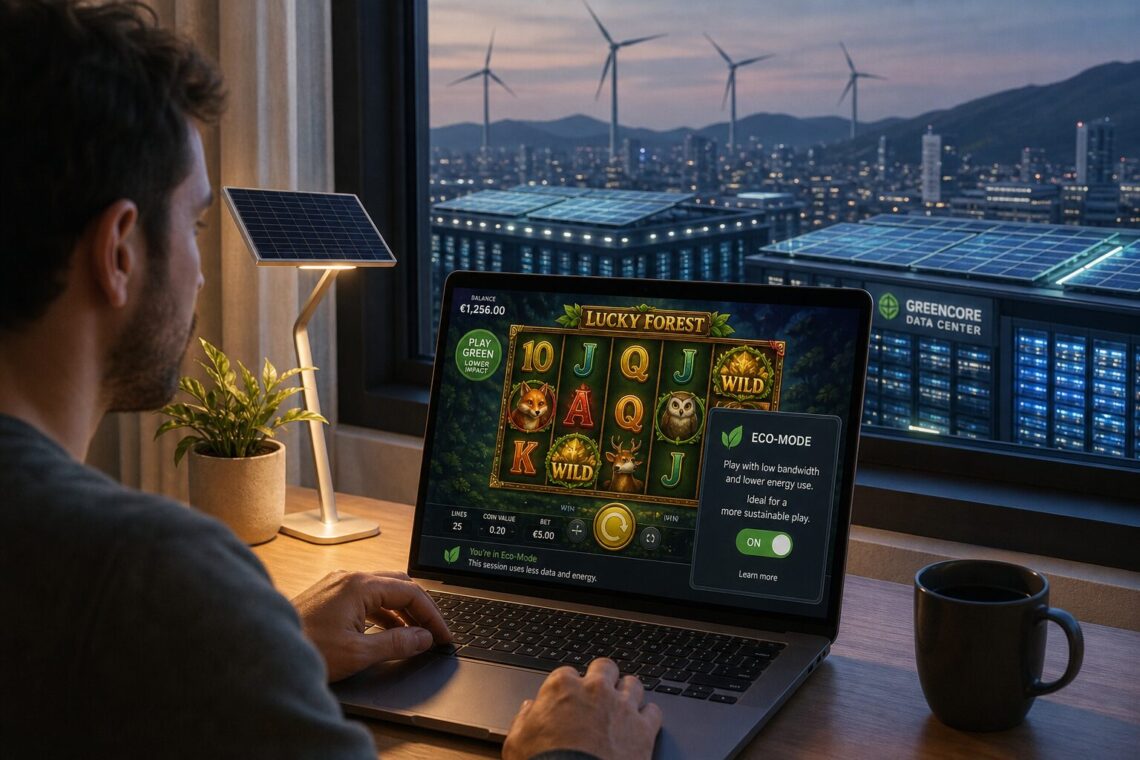
When the Reels Go Green: An Unlikely Environmental Story
Most conversations about online slots focus on jackpots, UX, or legality. Few people picture a server rack humming like a hive or count the carbon in a spinning virtual reel. Yet the transition from mechanical casinos to cloud-based slot platforms has created an environmental footprint worth examining. This section reframes online slot play as an ecological system — not just pixels and code, but electricity, cooling, device lifecycles, and corporate carbon policies.
Think of every spin as a tiny request pinging a data center, triggering compute cycles, storage reads, and network transfers. Individually trivial, cumulatively significant: millions of spins per day scale to measurable energy use. Understanding that scale is the first step toward doing anything about it.
Data Centers, RNGs, and Where Energy Is Spent
Random number generators, animation engines, live dealer streams, payment processing, and analytics all live on servers. Live dealer slots, in particular, combine streaming video with real-time game logic — multiply resource needs by the number of concurrent players.
Fortunately, not all data center power is equal. Hyperscale providers vary by energy mix and PUE (power usage effectiveness). Operators that colocate with renewables or buy offsite wind and solar reduce net emissions. Some gaming companies publish sustainability reports or commit to UN-aligned net-zero pathways; others still run on carbon-heavy grids. For players interested in impact, choosing platforms hosted on green clouds or those with transparent energy policies matters.
The Hidden Benefit: Fewer Flights, Fewer Machines
A surprising sustainability advantage of online slots is avoided physical travel. In-person gambling often involves flights, hotel nights, and beefed-up casino floors — all carbon-intensive. A player staying home to spin reduces those travel emissions. Likewise, the decline of mechanical slot manufacturing lowers demand for heavy-duty metal cabinets, lighting, and short-lived electronics that end up as e-waste.
This is not a free pass: online play shifts the footprint rather than erasing it. But when operators and consumers prioritize efficiency, remote play can be a lower-carbon alternative to destination gambling.
E-waste, Device Lifecycles, and Responsible Design
Most online slots are consumed via smartphones, tablets, and laptops. Device turnover drives a major portion of tech-related emissions and e-waste. Slot companies can influence this by optimizing games for older hardware, offering lightweight web builds, and avoiding constant forced updates that shorten device usefulness.
Designing with longevity also reduces pressure on supply chains for rare minerals. When game creators prioritize backward compatibility and small install sizes, they help extend players’ device lifespans and reduce downstream environmental harm.
Green Game Design: From Tokenomics to Carbon Offsets
Several innovative approaches can make playing slots greener. Tokenomics in blockchain-based slots could be structured to reward players for lower-impact behaviors (off-peak play, smaller file sizes, or using green-hosted wallets). Platforms can embed micro-donations to conservation projects — a fraction of the rake that funds reforestation or marine protection, paired with transparent impact reporting.
Operators can also purchase renewable energy credits, invest in on-site solar for studio streams, or adopt carbon accounting frameworks like the GHG Protocol. Certification badges from third parties help customers make informed choices. For players, small actions — enabling low-bandwidth modes, choosing audio-only streams, or supporting operators that publish sustainability metrics — add up.
Regulation, Transparency, and the Next Level of Accountability
As ESG reporting becomes mainstream, regulators and industry bodies may begin requiring gaming companies to disclose energy and emissions data. That transparency would shift competition: platforms with better environmental performance could market against those that don’t. Standards could emerge around data center sourcing, device optimization, and responsible marketing that discourages binge play patterns that increase resource use.
Players and advocates can accelerate this by asking questions, favoring greener brands, and supporting policies that reward sustainable digital entertainment.
A Practical Playbook for Eco-Conscious Players
Players who want to reduce their slot-related environmental footprint can take concrete steps: enable battery-saving and low-bandwidth modes, play during off-peak grid hours in regions with variable renewable supply, choose operators with sustainability disclosures, and use devices longer before upgrading.
Beyond personal choices, supporting operators that invest in renewables, offsetting emissions from big wins, or donating a portion of play to conservation initiatives creates an industry-wide incentive to green the reels.
Conclusion: Turning a Leisure Habit into a Climate Opportunity
Online slots are a mirror of our digital society: compact, addictive, and resource-driven. Seeing the environmental angle reveals new leverage points — from server choices and game design to player habits and corporate disclosure. If stakeholders treat sustainability as a design constraint rather than an afterthought, the pastime of spinning reels could help, rather than hinder, the transition to a lower-carbon digital future.
The next time you press spin, imagine the invisible ledger of kilowatt-hours behind it. That awareness is the first move toward greener play.